
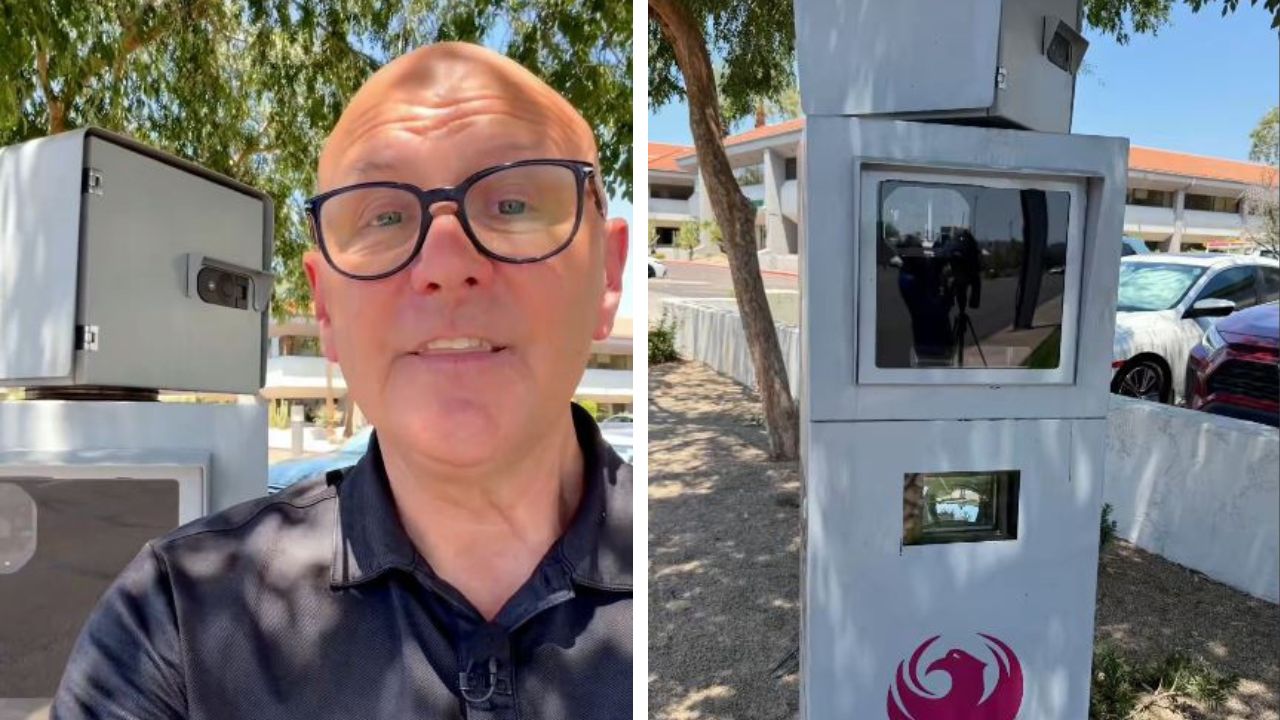
A video shared to X by the account @WallStreetApes, originally posted to TikTok by @12newsaz, showed a TikToker describing Phoenix's photo speed enforcement program and a woman's experience being served a ticket in person at her home.
The TikToker described a worker who arrived at the woman's door dressed in a way she compared to a delivery driver. They asked for a signature confirming she had received her ticket.
According to the TikToker, who described the woman's account, she was not home when the worker arrived, and communicated with him through her Ring doorbell camera.
@12newsaz A Phoenix woman says a process server dressed like an Amazon worker delivered her $250 ticket to her door.
♬ original sound - 12newsaz - 12newsaz
"I'm actually with the city of Phoenix," the worker told her, according to the video. "We're just making sure that you received our ticket." She called the visit "crazy" in the clip.
The X account explained how the system worked in the caption, writing that the city "outsourced the ticket program to a company called Verra Mobility," which handles installing the cameras, processing images, mailing and serving notices to people.
They added that Verra Mobility receives "a base fee of about $3,000 per camera per month plus $20 for every ticket that gets paid."
Reacting to the video, one commenter compared the U.S. system with automated enforcement in China, writing, "Meanwhile in China, if the surveillance cameras catch you speeding, the AI would instantly take a fine from your digital wallet WeChat. And you could lose 20 social credit points."
Another user argued police departments themselves function similarly to private companies despite being labeled public servants, writing that both operate as "legal entities."
According to the Phoenix New Times, the city pays Verra Mobility $3,000 per month for each of its 17 cameras, totaling roughly $612,000 annually, plus $20 for every ticket that gets paid.
Look if you don't pay the ticket then I have no sympathy. The real question is does the city save money in the process versus handling this all on its own? If not then why do it? If they do then great. When a city outsources they are building the economy.
— B. Wilson (@BWilson91830844) July 28, 2026
The city's Photo Safety Program uses 17 speed-monitoring cameras placed along high-crash corridors and near school zones, and requires drivers to be going at least 11 miles per hour over the posted limit and pass two warning signs before a citation is triggered.
One commenter pushed back on the outrage, arguing, "Look if you don't pay the ticket then I have no sympathy. The real question is does the city save money in the process versus handling this all on its own? If not then why do it? If they do then great. When a city outsources they are building the economy."
The Daily Dot could not independently verify the identity of the woman described in the video or the specific details of her encounter. Financial figures related to Verra Mobility are sourced to the Phoenix New Times. Claims made by commenters, including descriptions of China's enforcement system, were not independently verified. The details above reflect the video as shared by @12newsaz on TikTok and @WallStreetApes on X.