
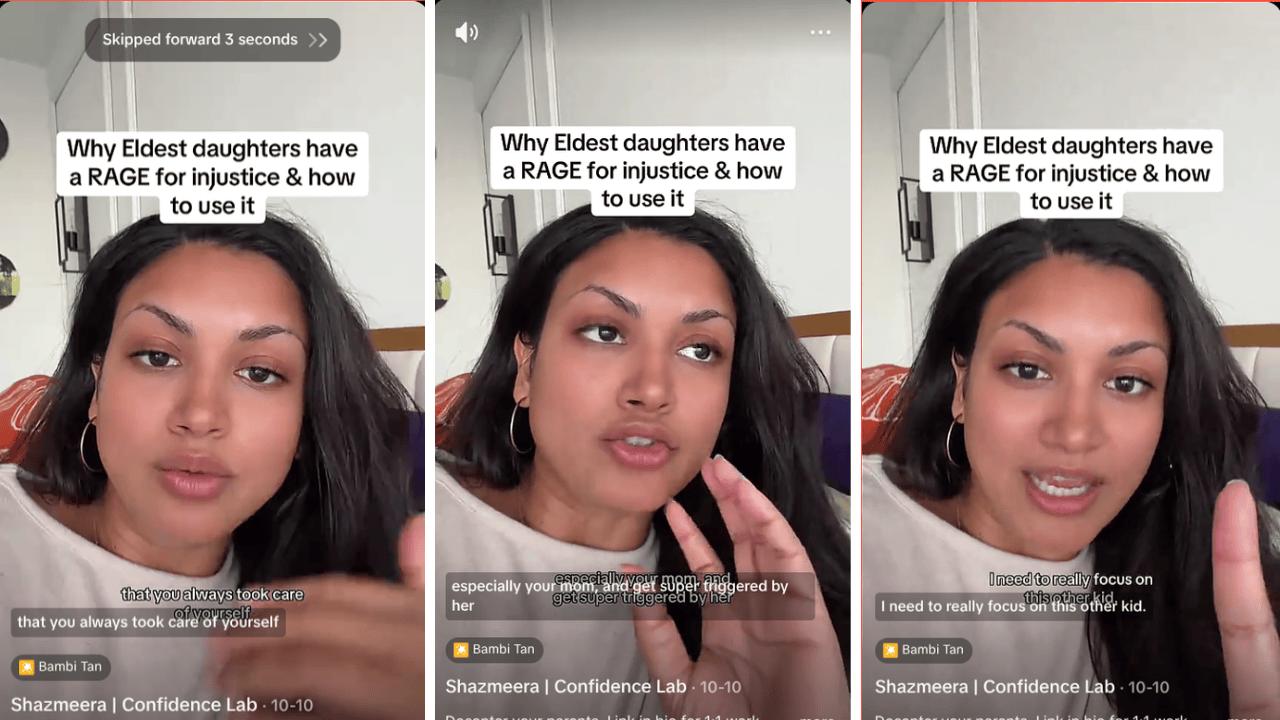
A TikToker that goes by @shazmeeraqadri shared a video, which has received 40,600 views and 134 comments as of publication, described the eldest daughter's rage and intolerance for injustice as a result of their parents' expectations as the older sibling. She said that both parents, but more so mothers, tend to perceive the eldest daughter as needing their love, care, attention, and affection less than their younger siblings. As a result, the eldest sibling doesn't experience a real childhood, because they're often expected to help raise the younger sibling.
Shazmeera explained that eldest daughters in family dynamics often get triggered by their mothers because they have created a false belief that, because she is the eldest, she has always taken care of herself. Or, at least, had needed much less supervision and is more self-sufficient at a younger age.
As a result, the parent/parents tend to think the eldest daughter is perfectly fine managing on her own, and so their attention is drawn to the more seemingly vulnerable and dependent younger siblings. However, she explained that, from the older sibling's perspective, they needed their parents just as much as their younger siblings, even though the latter might've needed them more.
Basically, they're dealing with a bit of emotional neglect. And, in addition, they also position the eldest daughter as a caregiver over the little ones, which fast-tracks their maturity. Then slowly, resentment is built toward both the parents and siblings.
Shazmeera then said that this feels like a form of injustice to the older child, and as they grow older, it forms into a hyper-awareness of any form of injustice or unfairness. She then explained that she notices this strong intolerance for injustice in many of her clients who are elder daughters, and even as adults, when they revisit their parents, they still see them taking the side of the younger sibling, just as it was when they were a child.
Parents Often Don't Recognize the Eldest Daughter's Injustice, Even in Adulthood
Shazmeera explained further that, even as an adult, parents still don't consider the injustice that was done to the eldest daughter in childhood. She said the need for the eldest sibling to get their parents to take accountability for accelerating their childhood is the driving force behind these disagreements.
The eldest daughter simply needs her parents to validate the feeling of unfairness that she's held onto since childhood. But she said this can lead to a negative cycle of feeling the need to convince their parents of their reality, especially if they don't validate those feelings. She said, "The more you do that, the more that you're going to reinforce the pattern in you that, a.) You are not allowed to be misunderstood, and b.) That you always need to convince people rather than walk away."
She concluded that the most logical solution for the eldest daughter to free herself from the need to validate her feelings of injustice is to decenter her parents. In other words, shift the focus from the need to feel seen or understood by them, and anchor within oneself. Because the reality is, accepting that some people won't change is freeing in and of itself.
Reactions to the post came mainly from commenters, mostly eldest daughters themselves, who could relate to the experience. Many of them felt like they grew up too quickly, and still hold resentment to this day.
One commenter said that they were upset by the favoritism shown to their other siblings. They wrote, "My rage is that they give free passes to my siblings for rules that I was told not to break."
Another commenter summed it up clearly. She wrote, "Basically you suppress your whole life living under the same roof and not becoming your fullest self 'cause you need to be accommodating while others get accommodated."
A separate commenter said that they now understand their NEED to be understood. They wrote, "I was wondering why I hate being misunderstood so much. I will over explain and made sure to remember every detail of an event when telling a story. Turns out this was the reason."