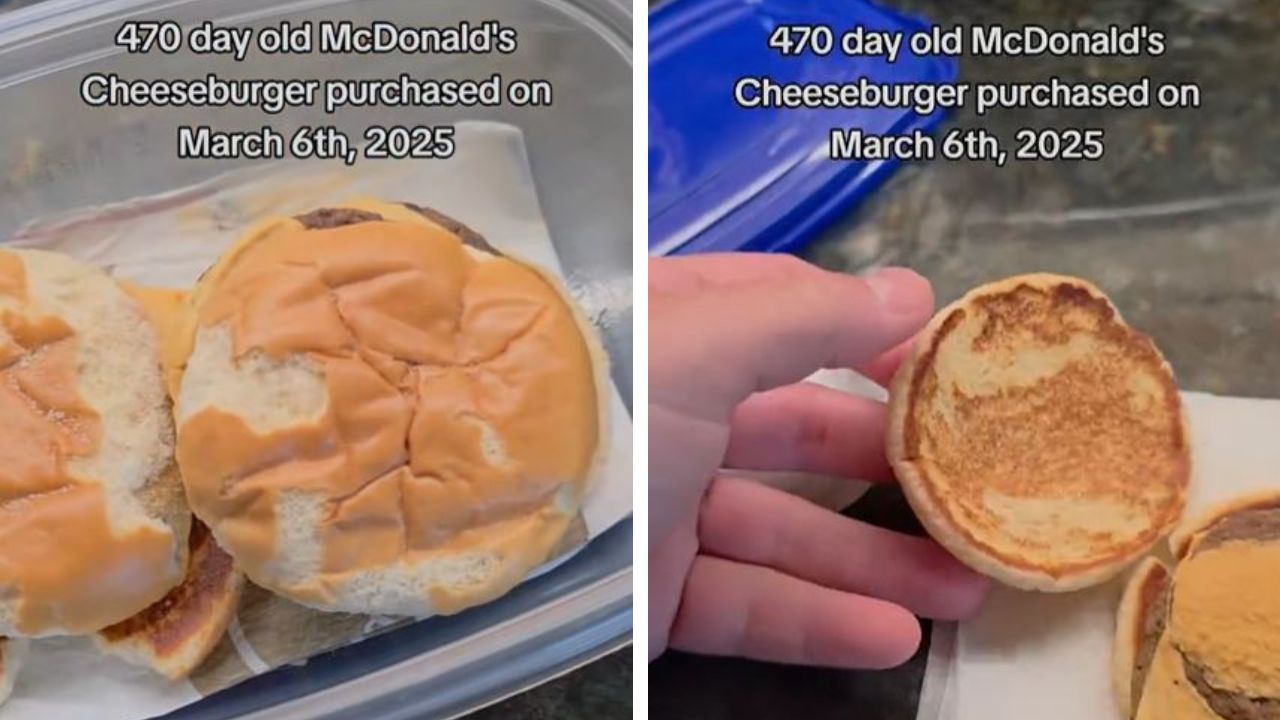
A TikTok posted by @kipchavez showed a McDonald's cheeseburger purchased on March 6, 2025, still intact, uncontaminated, and apparently mold-free 470 days later.
The clip was reshared on X by @WallStreetApes alongside a compilation of older social media posts about McDonald's burgers not decomposing, some dating back nearly two decades.
"This is not real food," @WallStreetApes wrote in the caption. "People need to stop eating this chemical poison." Food scientists dispute this characterization; the lack of mold is attributable to low moisture content rather than chemical preservation, as detailed below.
@kipchavez Did you think a 470 day old McDonald's Cheeseburger would look like this? #Food #McDonalds #Shocking
♬ Spooky, quiet, scary atmosphere piano songs - Skittlegirl Sound
The TikTok video begins with a McDonald's burger inside a blue plastic container lid, with @kipchavez claiming that it was bought on March 6, 2025. Removing it from a paper towel, the top bun appears slightly cracked and shriveled but carries no visible mold.
The bottom bun, the thin beef patty, and the cheese slice are similarly intact, with the cheese retaining a yellowish color and the patty remaining brown without visible rot.
The video then cuts to @WallStreetApes's screen recording of a separate post discussing a burger saved for nearly 18 years. That burger, shown in photographs, still holds its shape and color with no mold visible. The original bag and wrapper are reportedly still in the owner's possession. They then ask, "How is this still legal to sell as food?"
The same X post included a comparison with a Burger King Whopper: On day one, the burger appeared fresh; by day 34, it was covered in green and blue mold, according to the photos shown.
Several comments reflected the sentiment of the X user. "This really makes you think about what's in fast food," one commenter wrote. "Scary how it doesn't decompose."
Another reply told a personal story. "Someone once left a drunken 4am McGriddle purchase wrapped in a blanket [in a] bonfire in my trunk," one commenter wrote. "I found it 11 months later, mold-free, and completely in-tact [sic] beyond having petrified from drying out."
Food scientist Keith Warriner at the University of California has confirmed (via The Takeout) that any burger with a similar low moisture content, including one made at home with a thin patty, would produce the same result under the same dry conditions.
This is a 470 day old McDonald's cheeseburger
— Wall Street Apes (@WallStreetApes) June 21, 2026
The receipt is so old it’s deteriorated, but check out the burger bun, hamburger patty and the cheese. It’s all completely perfect
There is no mold, no discoloration, it still looks edible. I actually show a McDonald’s burger that’s… pic.twitter.com/V7syYRo6MC
One commenter did their own experiment with McDonald's food. "I got sick of hearing that @McDonalds food is fake & doesn't mold, so I stuck food in a bag & left it for 21 days," the commenter wrote, referencing a separate video showing molded McDonald's food as the result.
McDonald's itself has addressed the question directly, stating that without sufficient moisture, bacteria and mold may not grow, and that food prepared at home and left to dehydrate could see similar results. The company says its burgers are made with 100 percent USDA-inspected beef and contain no preservatives in the beef patty.
The Daily Dot was unable to independently verify the age of the cheeseburger shown in this video or the conditions under which it was stored. The details above reflect the accounts as shared on TikTok by @kipchavez and on X by @WallStreetApes.