A Twitter thread prompted by a Minnesota woman stands as a stark reminder that Black Americans are still only a few generations removed from slavery.
On Saturday, Jocelyn Mammen shared how, growing up, she lived with her great grandmother whose parents were born slaves. “It wasn’t that long ago,” she wrote.
https://twitter.com/blurbette/status/1132404563535966208
Her tweet soon prompted hundreds to share how easy it was to trace slavery in their own families. Many had grandparents or great-grandparents whose parents were slaves or were directly impacted by slavery by becoming sharecroppers.
"Even after emancipation, some were forced into becoming sharecroppers, which was just another form of slavery," Mammen, who identifies as a disabled stay-at-home mom, told the Daily Dot in an email. "Then this country moved into the Jim Crow era...and in many ways, I’m not so sure that ended. The remnants of slavery are still very much with us."
I’m not sure how to count generations. My grandma (still alive) was a sharecropper. Her mom, too. Great great granny was a slave. On my mom’s side, my grandad’s (still alive) grand mother was a slave. Her children were sharecroppers
— A lep is a ball (@blubillyholiday) May 25, 2019
https://twitter.com/jelani9/status/1133144441450094594
https://twitter.com/djfromthe4/status/1132630974649577473
That there are people alive who can talk about their close proximity to slavery is a testament to how recent it is in our history. Yet, these reminders need to be shared and re-shared because accounts of slavery continue to be disputed, or whitewashed, or even re-enforced in present day through institutional racism.
"I’ve noticed, particularly on Twitter, many people mainly on the right politically being dismissive of Black history, culture, and contributions. We still hear 'Get over it, slavery was so long ago,' but it wasn’t," she says.
5 generations from enslavement. My grandmother was older than I am now when she was finally able to vote. My mother was an adult when Jim Crow was formally dismantled. I’m 46 years old. It’s all very recent. https://t.co/P4JuQk1WH0
— Imani Perry (@imaniperry) May 27, 2019
https://twitter.com/bklyn_momjeans/status/1132438589978099712
I remember visiting my great grandmother Mamie & going on bus rides with her when I was little. She was born in 1890. Her father was born a slave. And she told me her grandmother was a cook on a plantation in Louisiana. Just 4 generations back to slavery. Really not that long ago
— Leslie PT (@itz_lezli) May 26, 2019
That ledger must be a wonderful gift!
— Emmerdoesn't (@NotMYRep) May 28, 2019
It's so neat to be able to read stuff that ancestors wrote, isn't it?
Tangible objects are always cool, too, but *writing* adds a whole 'nother level of intimacy & closeness to them?
https://twitter.com/AuthorTOBurnett/status/1132793761866637314
It eventually inspired the hashtag #NotThatLongAgo, which many used to share their accounts:
I am the daughter of Patricia-who is the daughter of Wilma-who is the daughter of Grace-who is the daughter of enslaved people-here in the United States of America..#notthatlongago
— Bronxstar Payne (@Bronxstar2) May 26, 2019
https://twitter.com/erintheeducator/status/1133339453173452802
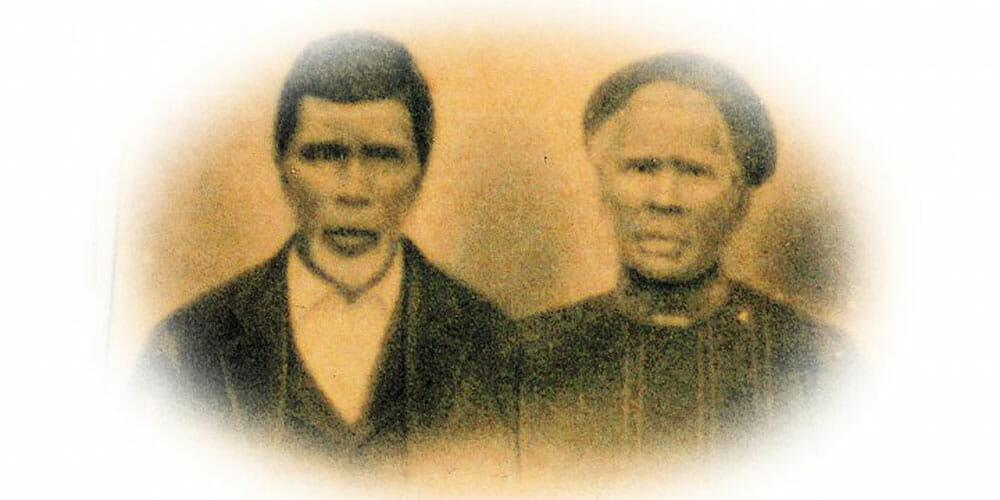
Some also shared instances where a family member was able to acquire land from their slave owners. Bryndis Roberts shared a photo of her great-great-grandparents, who she identified as Richard and Edie Spencer in a Twitter message with the Daily Dot. In follow-up tweets, she explained the image: "There was a familial relationship between my maternal Black ancestors and their white slaveholders. Because of that relationship, the white slaveholders, who were also my ancestors, sold land to my maternal Black ancestors...after the end of the Civil War. Being landowners afforded my maternal Black ancestors a higher standard of living and access to things like photography."
This is my maternal great-great grandmother, Claudia. Born a few years after emancipation, her early years were in captivity. There are plenty of other stories to be told in her lineage of labor & enclosure. It's not far, at all. pic.twitter.com/CQ7GqOUCRJ
— amara k. (@amarakali) May 27, 2019
These are my maternal great-great-grandparents. They were born in the 1840s. They were enslaved. pic.twitter.com/ETbXyGkqUO
— Auntie Deesa (@DeesaRoberts) May 26, 2019
My great great grandfather was a slave, he was freed and then bought property in Kentucky. I don't know how he did it but i tell myself during tough times i come from strong stock.
— Rogue1Nikki.bsky.social (@PenalvaCubana) May 26, 2019
My great grand parents were slaves. (My maternal side) He then bought some land from one of the cruelest families in Mississippi that my relatives still own until this day.
— Kofi (@Kofimagne) May 26, 2019
Mammen says she is pleased that her thread has "prompted a number of people to start researching their family genealogy and, better still, have these conversations with older family members now, while we still can."
It has also been a lesson for non-Black people, which is especially important in an education system that repeatedly sees numerous accounts of both teachers and students spewing racist slurs or enforcing practices that are insensitive and contribute to the erasure of slavery narratives.
This thread is powerful. I am a white woman (well mostly...my great, great grandmother was full Cherokee but everybody else was European). I am a high school English teacher who is constantly trying to get my students to understand just how recent these brutalities occurred.
— Rachel Russell (@BroncoNSDA) May 26, 2019
As a white southerner, I think about this often: Many people now in their 80s spent their childhoods in the care of elderly relatives who were children during the civil war. Some people in elected office today were *directly* influenced by people who thought slavery was “normal.”
— Andy has left the building (@andyspinks) May 26, 2019
https://twitter.com/kyteacher/status/1132698196508127232
this is why it completely baffles me when people say “oh slavery was so long ago forget it” because there are people ALIVE RIGHT NOW who KNEW SOMEBODY WHO WAS A SLAVE. that’s not long ago at all.
— em (@cactipoke) May 27, 2019
The thread even prompted some descendants of slave owners to acknowledge their family's past:
https://twitter.com/Tedards/status/1132738779704320000
https://twitter.com/thepbg/status/1132617181647257600
"Too many people want to forget it ever happened, but we can’t and shouldn’t," Mammen says. "It’s important to call it what it was, to look at who was hurt by it and who benefited. Most of the people responding are three to five generations removed from slavery. Look how far we’ve come...and just how far we have to go."