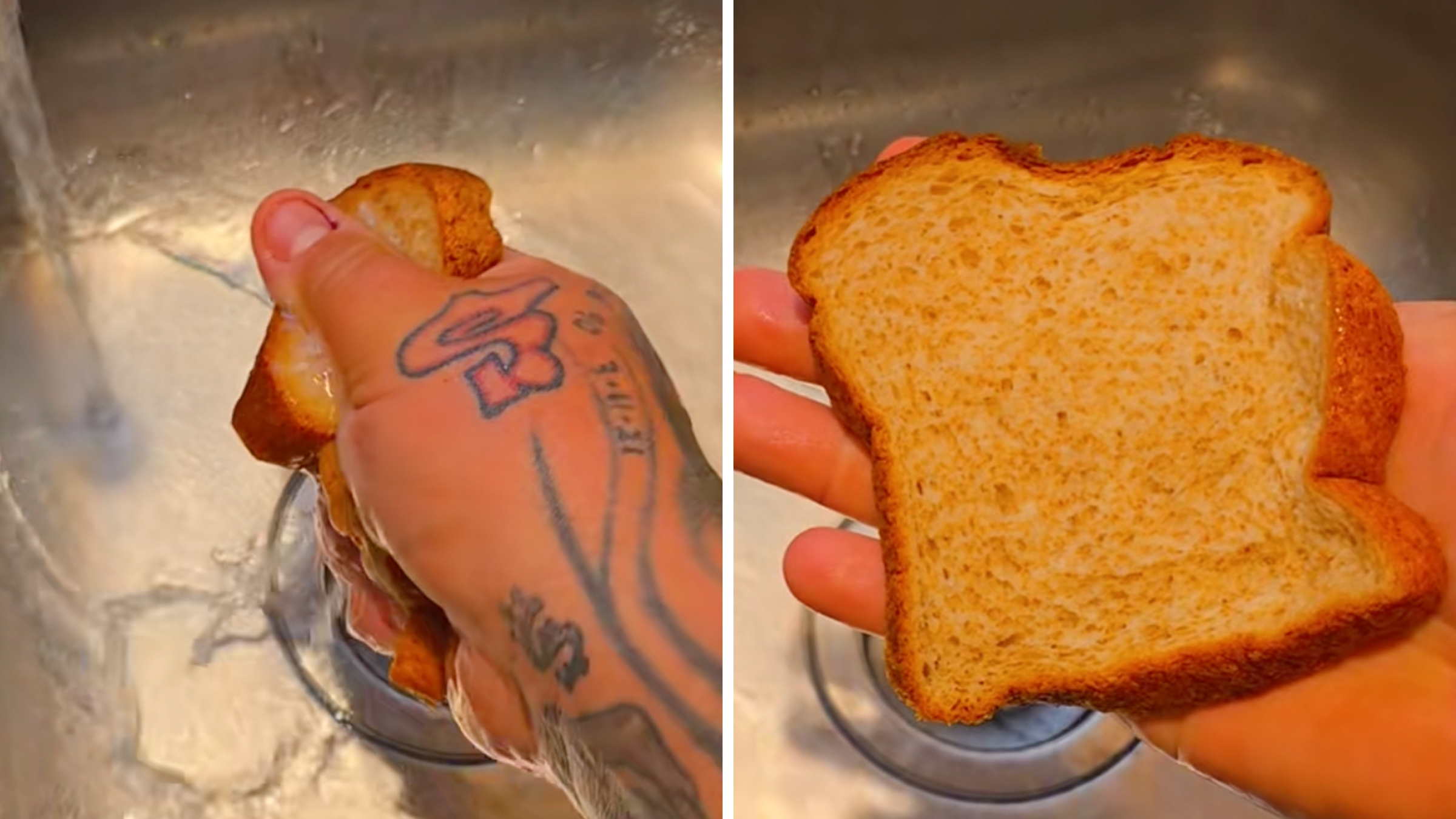
A new TikTok trend has reignited long-running concerns about what goes into American bread after creators began rinsing and squeezing slices under running water.
In many videos, the bread springs back into shape instead of falling apart, an outcome that has left viewers outside the U.S. horrified and Americans questioning what additives might be responsible.
TikTok's bread squeeze test, explained
Early this month, TikTok creator @lazywisdom2 followed the trend by rinsing a slice of Sara Lee honey wheat bread under the tap and squeezing it out. After multiple squeezes, the slice mostly retained its structure after releasing the water "like a sponge."
"What is going on?" he asked.
@lazywisdom2 what are they putting in our bread.. #saralee #bread #breadtok #fyp #sponge
♬ original sound - hilltophs
This trend stretches far back into 2025. Before getting it wet, TikTokers were squeezing bread slices into tight balls to show how they would bounce back without much, if any, structural damage.
@emmanuella_onyeka Best believe it is the same loaf that I ran under water and it didn’t budge.. #trendingsounds #trendingvideo #americantiktok?? #fypシ゚viral #breadtok #breadgonewrong
♬ original sound - SAINTED
"I’m convinced America is a science experiment," wrote commenter @appleuser53967444.
"Doesn’t happen here in Australia and New Zealand," claimed @pugilistfanatic.
Similar experiments, however, did not get the same results. TikToker @californiashyne tried it with Nature's Own honey wheat after watching a video of the brand's whole wheat stay together under pressure. His slice, however, stayed crumpled and ended up with holes.
Fellow bread lover @feedthefergs tried it with Nature's Own butterbread, which she buys because it doesn't have monoglycerides or diglycerides—common emulsifiers that help ingredients blend. Her slice also fell apart, leading her to blame these additives.
TikTok commentator @benchar07 even experimented with another Sara Lee variety, and it broke apart plenty.
Which additives are toughening U.S. bread?
Store-bought bread typically contains a number of additives designed to make it remain edible longer. Some of these reduce moisture absorption in order to inhibit mold and bacteria. Even sugar and honey contribute to this without having scary names like sodium benzoate.
According to Chowhound, mono- and diglycerides are indeed often added to bread to make the dough stronger while letting the bread remain soft. Any of these additives could help explain why some slices of bread spring back from the squeeze test like nothing happened.
Another explanation could be how hard you squeeze it. Some TikTokers appear to be a lot gentler with their experiments than others.
Many of these additives can still be found in Europe, Australia, and other nations, but may be less common.
In some countries, locals are more likely to buy fresh bread than mass-produced brands. Daily bakeries don't need to use additives that increase shelf life when customers usually eat the bread within days.
However, it's also true that the European Union has banned some ingredients that the U.S. still approves.
Some might remember the panic over azodicarbonamide (ADA), sometimes called the "yoga mat chemical." The European Union, China, India, and Australia banned ADA several years ago, but the U.S. says it's safe in small amounts.
The same is true with potassium bromate, another additive that strengthens dough. Despite U.S. legality, many companies voluntarily stopped using it and the ADA following consumer concerns.
The Daily Dot has reached out to Sara Lee via email and @lazywisdom2 via TikTok.
The internet is chaotic—but we’ll break it down for you in one daily email. Sign up for the Daily Dot’s newsletter here.